Try to guess where these Gothic masterpieces of art are. For each piece of art, tell me, at least one element typical from Gothic art or one of the characteristics of Gothic art that you can observe in the image:
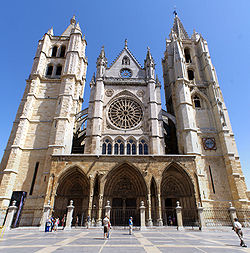
a) Leon Cathedral, the rose window, facade b) Basilica de Santa María del Mar, the colums c) Lonja de la Seda, the groing vault, colums d) Palace of the Generalitad, pointed arch,colums e) The Cuenca's Cathedral, the rose window, facade f) The Toledo's Cathedral,the towers pointed arch g) Remi's Cathedral, the rose window, facade, the towers h) Burgos' Cathedral, the gable j) Virgen dels Consellers
a.) Catedral de León b.) Basilica Santa Maria del Mar c.) La Lonja de mercaderes de Valencia d.) Palacio de la Generalidad de Cataluña e.) Catedral de Cuenca f.) Catedral de Toledo g.) Catedral de rReims en Francia h.) Catedral de Burgos. i.) Catedral de León j.) Museo nacional del arte de Cataluña Virgen del Conseller.
a) catedral de león b) basílica de santa María del Mar en Barcelona c) la lonja de mercaderes de valencia d) palacio de la generalidad de Cataluña e) catedral de cuenca f) catedral de Toledo g) catedral de Reims en Francia h) catedral de burgos i) catedral de león j) verge dels consellers (1443-1445) museo de Cataluña
a. Catedral de León b. Basílica de Santa María del Mar c. Salón de las columnas de la lonja de la seda (Valencia) d. Patio gótico del Palau de la Generalitat e. Catedral de Cuenca f. Catedral de Toledo g. Catedral de Reins, Francia h. Puerta de la catedral de Burgos i. Virgen Blanca de la catedral de León j. Retablo de los concejales. Autor: Lluis Dalmau, Museo de Arte de Cataluña (Barcelona)
a) Rosetón y arcos apuntados b) Ventanales y muy alto c) bóveda de crucería y muy alto d) arcos apuntados y muy alto e) Rosetón y arcos apuntados f) arcos apuntados y muy alto g) Rosetón y muy alto h) arco apuntado y estatuillas en las arquivoltas y en el tímpano i) expresan sentimientos y existe la línea curva j) riqueza en colores y el uso del color dorado
Read this information and answer the quiz questions: Knights belonged to the noble class and were part of a military order, but not all soldiers could become knights. Training began at a very young age. At 7, the son of a medieval nobleman or knight would be sent off to serve as a page in a lord's castle. There, he would learn horsemanship, archery and swordsmanship, and perform various other duties around the castle. Squires would begin training at age 14 years old. A squire's training concentrated on strength, fitness and skill with various weapons. Individual training was only part of the regimen, as knights also needed to know how to fight as part of a team of skilled horsemen. The squire would care for the knight's horse, clean the stables, polish the knight's armor and maintain his weapons. They would learn the chivalric codes of conduct and listen to epic tales of Roland, Charlemagne, Arthur, Percival and Lancelot. After years ...
All Nobel Prizes are awarded in Stockholm, Sweden, except for the Nobel Peace Prize, which is awarded in Oslo, Norway. The founder of the Nobel Prize, Alfred Nobel, was a Swedish cosmopolitan. In his will, he declared that the Nobel Peace Prize should be awarded by a Norwegian committee. A nomination for the Nobel Peace Prize may be submitted by any person who meets the nomination criteria. A letter of invitation to submit is not required. The names of the nominees and other information about the nominations cannot be revealed until 50 years later. Joseph Stalin , the Secretary General of the Communist Party of the Soviet Union (1922-1953), was nominated for the Nobel Peace Prize in 1945 and 1948 for his efforts to end World War II. Adolf Hitler was nominated once in 1939. Incredulous though it may seem today, the Nazi dictator Adolf Hitler was nominated for the Nobel Peace Prize in 1939, by a member of the Swedish parliament, an E.G.C. Brandt. Answer ...
a) Leon Cathedral, the rose window, facade
ReplyDeleteb) Basilica de Santa María del Mar, the colums
c) Lonja de la Seda, the groing vault, colums
d) Palace of the Generalitad, pointed arch,colums
e) The Cuenca's Cathedral, the rose window, facade
f) The Toledo's Cathedral,the towers pointed arch
g) Remi's Cathedral, the rose window, facade, the towers
h) Burgos' Cathedral, the gable
j) Virgen dels Consellers
a.) Catedral de León
ReplyDeleteb.) Basilica Santa Maria del Mar
c.) La Lonja de mercaderes de Valencia
d.) Palacio de la Generalidad de Cataluña
e.) Catedral de Cuenca
f.) Catedral de Toledo
g.) Catedral de rReims en Francia
h.) Catedral de Burgos.
i.) Catedral de León
j.) Museo nacional del arte de Cataluña Virgen del Conseller.
a) catedral de león
ReplyDeleteb) basílica de santa María del Mar en Barcelona
c) la lonja de mercaderes de valencia
d) palacio de la generalidad de Cataluña
e) catedral de cuenca f) catedral de Toledo
g) catedral de Reims en Francia
h) catedral de burgos
i) catedral de león
j) verge dels consellers (1443-1445) museo de Cataluña
a. Catedral de León
ReplyDeleteb. Basílica de Santa María del Mar
c. Salón de las columnas de la lonja de la seda (Valencia)
d. Patio gótico del Palau de la Generalitat
e. Catedral de Cuenca
f. Catedral de Toledo
g. Catedral de Reins, Francia
h. Puerta de la catedral de Burgos
i. Virgen Blanca de la catedral de León
j. Retablo de los concejales. Autor: Lluis Dalmau, Museo de Arte de Cataluña (Barcelona)
a) Rosetón y arcos apuntados
ReplyDeleteb) Ventanales y muy alto
c) bóveda de crucería y muy alto
d) arcos apuntados y muy alto
e) Rosetón y arcos apuntados
f) arcos apuntados y muy alto
g) Rosetón y muy alto
h) arco apuntado y estatuillas en las arquivoltas y en el tímpano
i) expresan sentimientos y existe la línea curva
j) riqueza en colores y el uso del color dorado